The 2025 AI AWARDS

2025didnotfeellikeanormalyearinAI.Itfeltlikeacompleterevolution. Reasoningstoppedbeinganichetrickandbecamethestandard.Efficiencystoppedbeingafootnoteandbecamethebattlefield.Multimodalstoppedmeaning“itcanseepictures”andstartedmeaning“thisthingcanliveinsideyourworkflow.” Sothisisnotapopularitylist.Itisamapofwhatactuallymovedtheindustry.Eachawardisjudgedonfourthings:consistentoutput,realcapability,adoption,andtheeconomicsbehindit.Thewinnerisnotalwaystheflashiestdemo.Itistheteamortoolthatheldupwhenpeopletriedtoshipwithit. Ifyouonlyreadonesection,readModeloftheYear.IttellsyouwhatAIstartedtofeellikein2025whenitactuallyworks
The year intelligence learned to reason, got cheaper, and went multimodal.
2025 had two moods.
First: reasoning became the default expectation, not a bonus feature. Google shipped “thinking” models at scale (Gemini 2.5 Pro in March, then more throughout the year).
Second: the economics snapped into focus. Mixture-of-Experts (MoE) went from “cool paper idea” to “the cost curve,” and open models got shockingly competitive. DeepSeek’s V3 technical report is the cleanest proof point: 671B total parameters, 37B active per token, built explicitly for cost-effective training and inference.
Layer on top: multimodal stopped meaning “it can see images” and started meaning “text, images, video, audio, code” in one system. Google’s Gemini 3 positioning is explicit here.
These awards are my attempt to capture that year honestly, in a way you can skim and still learn something. (And yes, this is opinionated by design. The rubric is simple: consistency, capability, adoption, and economics.)
1) Model of the Year
Winner: Claude Sonnet 4.5
Runner-up: Claude Opus 4.5
What it represents: the single model that felt most reliable for real work. Not the flashiest demo. The one that stayed solid in production-ish usage.
Winner verdict: Sonnet 4.5 was the most “get it done” model of 2025.
Why it won:
- Coding that holds up under pressure. Anthropic positions Sonnet 4.5 as state-of-the-art on SWE-bench Verified, with strong results on real-world software tasks.
- Agentic stamina. Anthropic reports it can maintain focus for very long, multi-step workflows, which is exactly where weaker models drift or collapse.
- Computer-use leap. Sonnet 4.5 is framed as a major step for “computer use,” which matters because 2025 was the year “agents” moved from talk to tooling.
Criticism: It’s still not a universal tool. Claude is exceptional for writing and software engineering, but it’s not trying to win the “generate everything” battle.
Why this matters for 2026: Consistency is the hidden requirement for anything resembling “general” intelligence. Sonnet 4.5 didn’t solve inconsistency, but it raised the floor. And the floor matters more than the ceiling when you are building workflows.
2) Most Important Architectural Innovation
Winner: Mixture-of-Experts, mainstreamed by DeepSeek-V3

What it represents: the architecture that bent the cost curve.
Winner verdict: MoE made “serious model performance” cheaper to train and cheaper to run.
Why it won:
- Selective activation. DeepSeek-V3’s report is the crisp explanation: huge model, but only a subset activates per token, improving efficiency.
- A practical benchmark for the world. When a major lab publishes a recipe that hits near-frontier performance with documented training cost constraints, it changes what everyone else feels is possible.
Criticism: MoE is not free. Routing and serving complexity is real, and “cheap to train” does not automatically mean “simple to deploy.”
Why this matters for 2026: If 2024 was “bigger models,” and early 2025 was “reasoning models,” late 2025 quietly became “efficient models.” Efficiency is what takes AI from demos to defaults.
3) Best Image Generation Model
Winner: Nano Banana Pro (Google DeepMind)
What it represents: the visual model that made images feel usable, not just impressive.
Winner verdict: Nano Banana Pro pushed character consistency and controllable editing into mainstream expectations.
Why it won:
- Google positions Nano Banana Pro as a state-of-the-art image generation and editing model with professional controls and strong text rendering.
- It’s also presented as building toward “world knowledge” style usefulness, including diagrams and infographics, not just pretty pictures.
Criticism: As with all top-tier image tools, creators still need clarity on training data and usage rights, and platforms will keep tightening policies.
Why this matters for 2026: Images are the gateway drug for AI adoption. If your first AI “wow moment” isn’t a chat, it’s a visual. When generation becomes consistent, the tool stops being a toy.
4) AI Company of the Year
Winner: Google (Gemini ecosystem + DeepMind execution)
What it represents: the company that shipped across modalities and moved adoption, not just benchmarks.
Winner verdict: 2025 was Google’s comeback year.
Why it won:
- A credible reasoning climb. Gemini 2.5 Pro launched as a “thinking” model and was framed as top-tier across benchmarks.
- Best-in-class multimodal breadth. Gemini 3 is positioned explicitly as text, images, video, audio, and code.
- Video with native audio went mainstream. Veo 3 is marketed as generating audio natively, including sound effects and dialogue.
- Adoption at absurd scale. Google reported AI Overviews reaching more than 1.5B users monthly, and AI Mode rolled out more broadly in 2025.
- Infrastructure matters. Google introduced Ironwood as an inference-focused TPU for the “age of inference,” reinforcing their vertical integration advantage.
Criticism: Google did not unambiguously own every niche. “Best coding model” remained contested at the top end, and some builders still preferred competitors in day-to-day workflows.
Why this matters for 2026: Profitability plus distribution is a cheat code. Google can fund research, ship product, and deploy to billions without asking permission.
5) Best Video Generation Model
Winner: Veo 3 (Google DeepMind)
What it represents: video that feels less like “AI clips” and more like a controllable medium.
Winner verdict: Veo 3 made “video + sound” feel like one coherent system.
Why it won:
- Google’s own model pages emphasize native audio generation, including dialogue and ambient sound.
- Veo 3’s integration into consumer-facing Gemini experiences pushed it past “research demo” status.
Criticism: The watermarking and provenance conversation is not optional anymore, and video is where trust issues will explode first.
Why this matters for 2026: Video is the highest-leverage format on the internet. Whoever makes it easy to generate responsibly will shape culture, marketing, and misinformation defenses at the same time.
6) Best Multimodal System
Winner: Gemini 3
What it represents: the closest thing to “one model to rule your workflow.”
Winner verdict: Gemini 3 is the cleanest “all-modal” story.
Why it won: Google frames Gemini 3 as world-leading multimodal understanding across text, images, video, audio, and code.
Criticism: True multimodal is still uneven. “Supports audio” and “reasons deeply about audio” are different things, and the UX layer often determines whether multimodal is usable.
Why this matters for 2026: The endgame is fewer tabs. When multimodal works, your workflow collapses into one conversation plus tools.
7) Research Lab of the Year
Winner: Google DeepMind
What it represents: the lab that advanced the frontier and shipped it.
Winner verdict: DeepMind didn’t just publish. It shipped.
Why it won: DeepMind powered multiple year-defining releases (Gemini 2.5/3, Veo 3, Nano Banana Pro) and maintained a pace that made “Google is behind” feel outdated.
Criticism: The obvious one is structural: more compute, more money, more distribution. But funding is not sufficient on its own, and 2025 proved execution still matters.
Why this matters for 2026: If you want a snapshot of how DeepMind thinks, watch The Thinking Game, which Google made available publicly.
8) Best Aggregator Platform
Co-winners, by workflow
What it represents: the “one subscription, many models” layer.
Because 2025 made something painfully clear: models specialize. Your best coding model is not your best writing model is not your best media model. Aggregators are how normal people survive that fragmentation.
Text / Research winner: Perplexity
Perplexity supports a “Best mode” that auto-selects models and allows picking advanced models in Pro, which is exactly what an aggregator should do.

Coding winner: Cursor
Cursor positions itself as an IDE that lets you choose between frontier models from OpenAI, Anthropic, and Google, and documents its supported models.
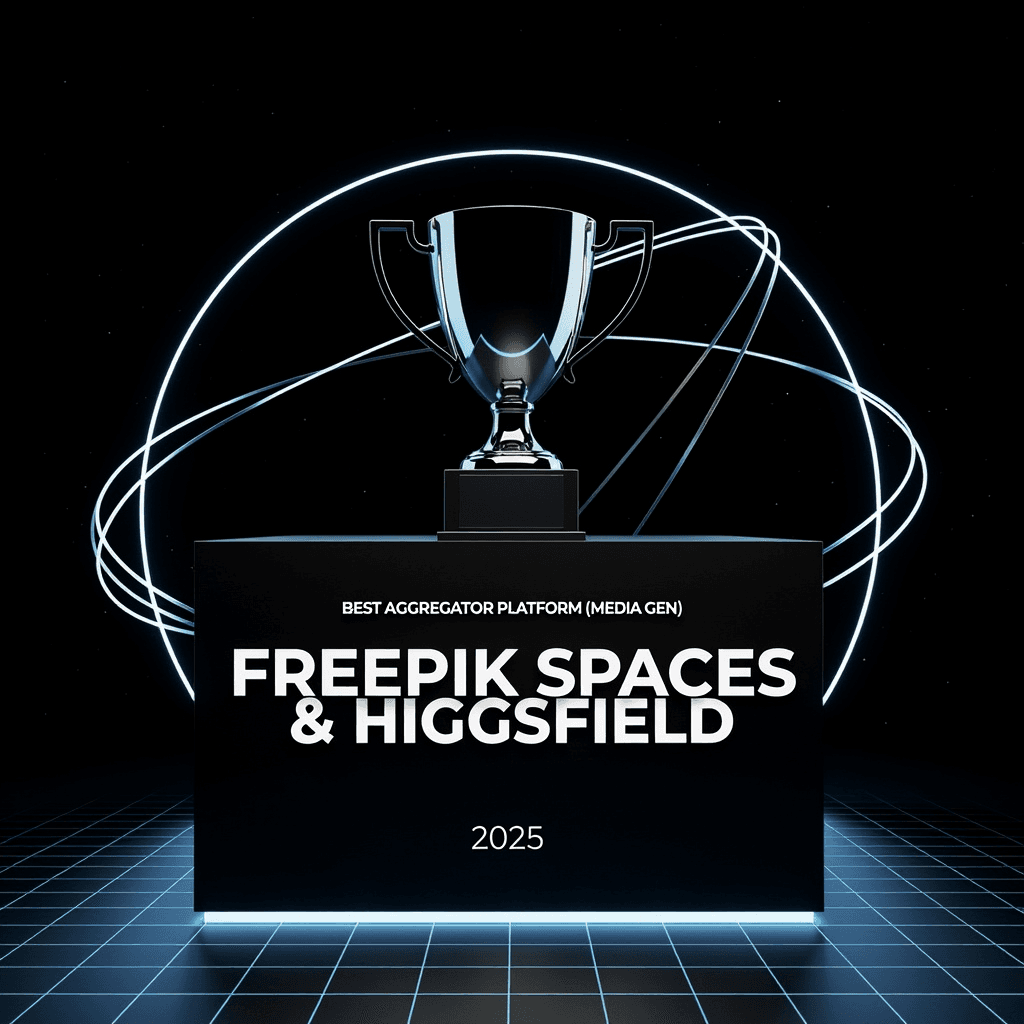
Media co-winners: Freepik Spaces + Higgsfield
Freepik Spaces is explicitly a node-based canvas connecting creative tools (image, video, audio, editing) into workflows.
Higgsfield built an end-to-end workflow platform focused on marketers and creators, integrating third-party systems with a consistency layer.
Why this matters for 2026: The aggregator layer will become the “operating system” for AI work. Most users will not care what model they used. They will care that the output shipped.
9) Best AI Adoption, Non-AI Company

Winner: Johnson & Johnson (JAIDA-GenAI)
What it represents: mature, scaled deployment inside a real enterprise.
Winner verdict: J&J treated AI like an operational discipline, not a demo.
Why it won: The Hackett Group’s 2025 Innovation Awards recognized J&J’s JAIDA-GenAI as the winner for AI/Automation Center of Excellence, highlighting its evolution since 2020, expansion across internal functions, and a structured methodology with expected 12–18 month payback.
Why this matters for 2026: This is the adoption blueprint. Models will keep improving. The winning companies will be the ones that can operationalize them safely and repeatedly.
10) AI for the People
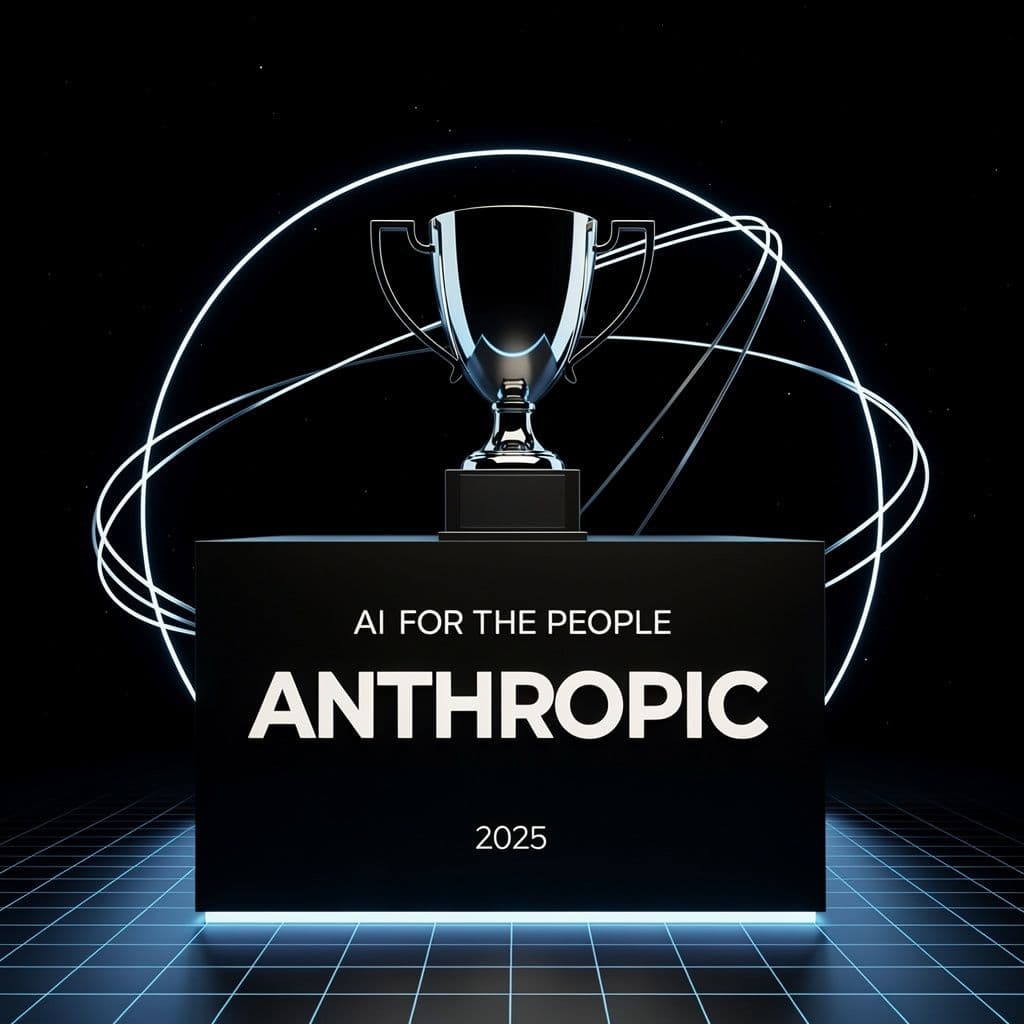
Winner: Anthropic
What it represents: the company most consciously optimizing for safety, alignment, and “humans first” product decisions.
Winner verdict: Anthropic made “trust” part of the product.
Why it won: Anthropic has consistently framed its work around safety and responsible deployment. And it’s one of the few companies whose user culture includes a real emotional attachment to the product.
Criticism (important): In late 2025, Anthropic changed its consumer terms so user chats and coding sessions could be used for training unless users opt out, with extended retention if you opt in. That surprised many users because it shifted the default expectations.
Why this matters for 2026: As AI becomes normal, the differentiator won’t just be IQ. It’ll be governance, privacy defaults, and user trust.
After-credits: Biggest Disappointment
Meta (Llama 4 era)
Meta entered 2025 with huge expectations for open models. Llama 4 landed in controversy, including public debate about benchmark optimization and what the leaderboards really meant. TechCrunch reported Meta denied claims of boosting benchmark scores.
Meta also marketed an “industry-leading” 10M context window for Llama 4 Scout, which intensified scrutiny when the community tested real-world behavior.
I’m not calling it a failure. I’m calling it a mismatch between expectations and perceived delivery. In an era where trust is part of the product, perception matters.
The real 2025 story, in one sentence
Reasoning raised the floor, MoE lowered the cost, and multimodal collapsed the workflow.
That’s why 2025 felt like a step change, not an incremental year.